Track a week of food waste and test one change
A one-week log of the food your household throws away, sorted by cause, so you can pick a single change and check whether it worked.

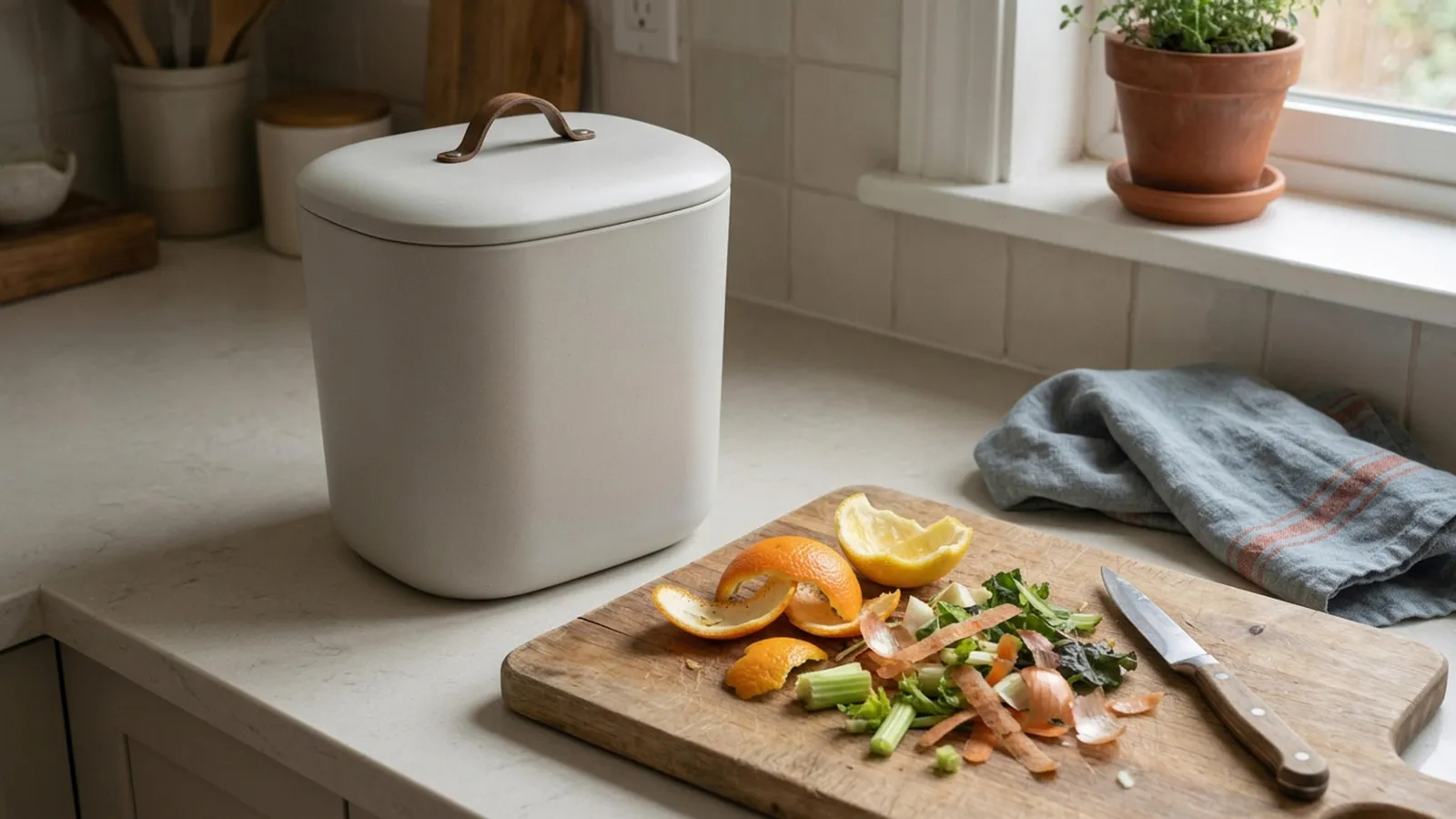
Most households know they throw some food away. Few know which food, how often or why. Without that, the usual fixes (shop less, cook more, buy smaller packs) are guesses.
A one-week log turns the guess into a short list. You write down what goes in the bin, sort it by cause, then change one thing and measure again. It takes a few minutes a day and no special equipment.
Why one week is enough to start
Federal agencies describe wasted food as a large, widespread problem. USDA says that in the United States over one-third of all available food goes uneaten through loss or waste (USDA, checked November 18, 2026). Estimates of what that costs a family differ. USDA’s page says the average American family of four loses $1,500 a year to uneaten food (USDA), while EPA’s page says the average family of four spends almost $3,000 a year on food that does not get eaten (EPA). Because the two figures differ, this guide does not rely on either. Your own log is a better guide to your own household than a national average.
EPA points readers to its Food: Too Good to Waste toolkit, which it says helps households work out how much food is really going to waste at home (EPA, checked November 18, 2026). The method below is a simple version of the same idea. It is general information, not a substitute for that toolkit.
Step 1: Set up a place to record waste
Pick one spot for the log: a note on your phone, a sheet of paper on the fridge or a page in the notebook you already use for household admin. Put a pen beside the kitchen bin if you use paper.
Decide what counts. A useful rule is anything edible that was bought or cooked for people to eat and ended up in the trash, compost or down the drain. Peels, bones and shells you would never have eaten can stay out. Keep the rule the same all week.
Tell everyone in the household what you are doing and why. The aim is information, not blame. If one person clears the fridge, they need to write things down too.
Step 2: Log each item as it goes
For every item, record four things: what it was, roughly how much, what it cost and why it was thrown out. A rough cost is fine. Estimate from what you remember paying, and use a round number.
For the reason, keep a short list of choices so entries stay quick:
- Went off before we used it
- Cooked too much
- Left over and forgotten
- Past the date on the label, never opened
- Did not like it or nobody wanted it
- Other (say what)
Note the date and the day of the week. Patterns by day often show up, such as a lot of waste on the Monday after a weekend away.
If something is unsafe, throw it out. The log is not a reason to keep food that has been left out too long or stored past safe limits. EPA’s advice is not to leave perishable food at room temperature for more than two hours (EPA, checked November 18, 2026).
Step 3: Sort the week’s entries by cause
At the end of the week, add up the cost for each reason and each food group. Here is an invented example for one household, with made-up amounts.
| Item | Rough cost | Reason | Group |
|---|---|---|---|
| Half a bag of salad greens | $2.00 | Went off | Produce |
| Two portions of cooked rice | $1.00 | Left over and forgotten | Leftovers |
| Half a loaf of bread | $1.50 | Went off | Bread |
| One tub of yogurt | $2.50 | Past the date, never opened | Dairy |
| Three bananas | $0.75 | Went off | Produce |
| One portion of chili | $2.25 | Left over and forgotten | Leftovers |
The total is $10.00. By group, leftovers are $3.25, produce $2.75, dairy $2.50 and bread $1.50. By reason, “left over and forgotten” is $3.25 and “went off” is $4.25.
The point is not the dollars. It is that two of the six entries are cooked food nobody remembered, and three are items that went off before anyone reached them. Those are two different problems with two different fixes.
Step 4: Pick one change that matches the biggest cause
Choose one change, not five. Match it to the pattern you found.
If leftovers are forgotten, give them a home: one shelf or one labeled container area in the fridge, with the date written on each. EPA suggests refrigerating or freezing leftovers in clear, labeled containers with dates, and freezing food you know will not be eaten in time (EPA, checked November 18, 2026).
If fresh produce goes off, check how it is stored and when it is bought. EPA describes keeping vegetables that wilt, such as leafy greens and carrots, in the high-humidity drawer, and fruits and vegetables that rot easily, such as mushrooms and peppers, in the low-humidity drawer. It also advises waiting to wash berries, cherries and grapes until you are ready to eat them (same source). Buying produce later in the week, or in smaller amounts, may also help.
If food is unopened and past a date, check what the label means. USDA notes that confusion over the meaning of dates can lead consumers to discard wholesome food, and that manufacturers provide dating to help consumers and retailers decide when food is of best quality (USDA, checked November 18, 2026). Dates on some products and safe storage times for cooked food are not the same thing, so use the product’s own guidance.
If you cooked too much, plan portions before cooking. Batch cooking for your real schedule covers portions and freezer space, and planning a week of meals covers matching shopping to the evenings you will actually eat at home.
Step 5: Run the change for a week and log again
Keep the same log rules and change only the one thing. At the end of the second week, compare the totals by cause. Did the targeted category fall? Did another one rise?
An invented comparison: if week one showed $3.25 of forgotten leftovers and week two shows $0.75 after a “leftover shelf” was introduced, that is a $2.50 drop in that category. But if waste from produce went up by $2.00 in the same week, the household has moved the problem rather than solved it. A single week is also noisy: a holiday, illness or trip changes what people eat. Treat the result as a signal, not a proof, and repeat if the week was unusual.
If the change worked, keep it and choose the next biggest cause. If it did not, try a different fix for the same cause before moving on.
Keep it light after the test
You do not need to log forever. A repeat week every few months, or after a big change such as a new job schedule or a new baby, is enough for most households. Add the habit to your regular routine; running a household without keeping every detail in your head covers ways to do that.
For what to buy and how to pay less for it, Money Master covers budgeting and saving (moneymaster.fyi). Which card to use for groceries is a Card Calculator question (cardcalculator.net).
Common questions
Do I have to weigh the food? No. Counts, rough portions and a rough cost are enough to see patterns.
Does composting count as waste? For this log, yes. Composting is better than landfill, but the aim here is to buy and cook less food you do not eat.
What if the numbers are small? Then your household may already waste little. Spot-check once a year rather than keeping a log.
What about food safety? Never keep food just to avoid waste. Check the FoodSafety.gov cold storage chart and the product label.
Sources checked November 18, 2026: EPA, Preventing Wasted Food at Home; USDA, Food Loss and Waste.