Batch cooking or convenience food: compare money and time
A worked comparison of batch cooking and convenience food that counts ingredients, energy, waste and your own time, so the answer comes from your numbers.

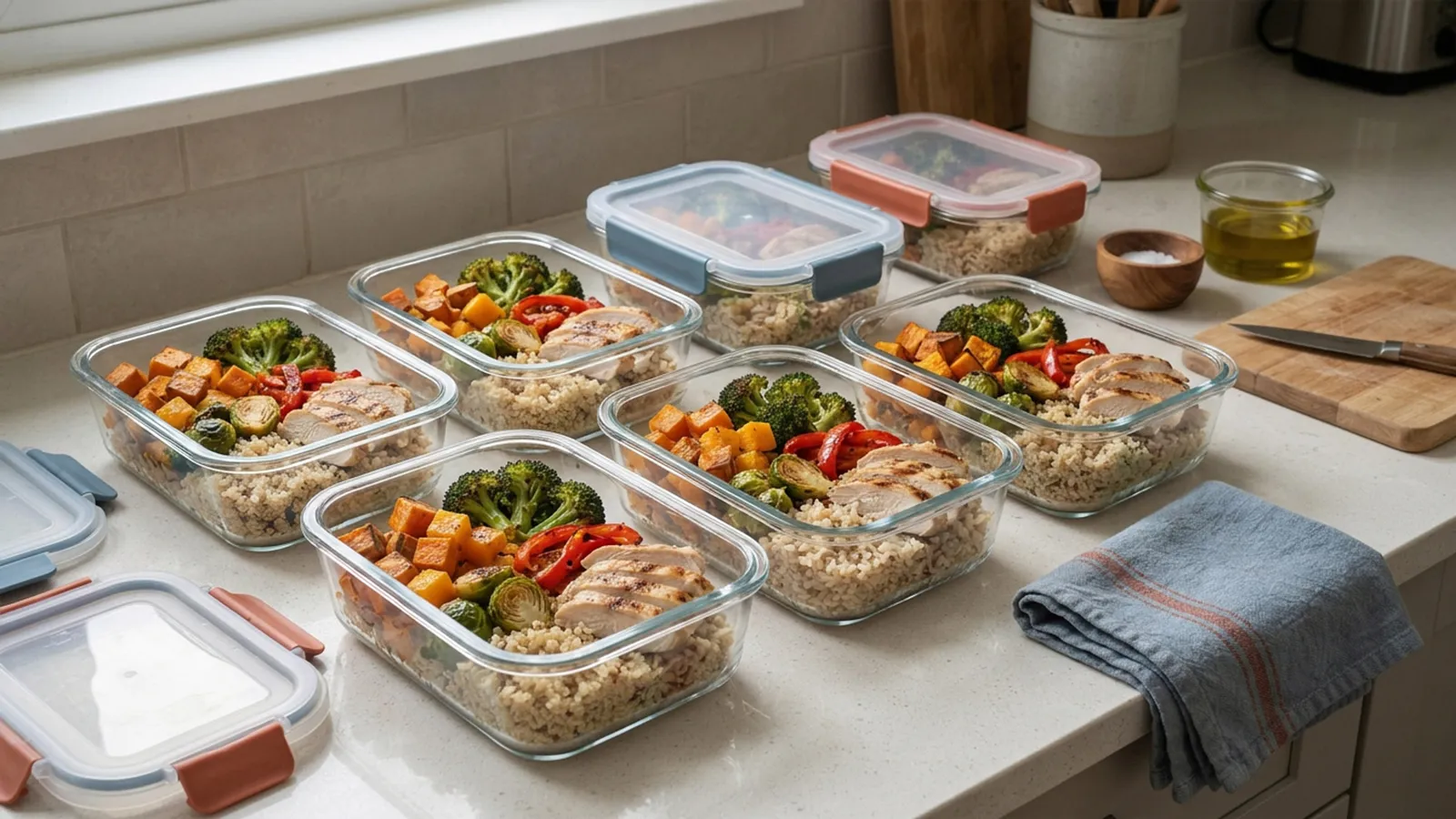
Batch cooking has a reputation for saving money. Convenience food has a reputation for costing more. Both reputations hold in some kitchens and fall apart in others, because the answer depends on four things people rarely count together: what the ingredients cost, what the cooking uses, how much gets thrown away and how long it takes.
This guide builds the comparison with invented numbers so you can swap in your own. The figures are not prices or averages. They show how the arithmetic works and where it can flip.
Decide what you are comparing
Pick one real meal. Chili, a pasta bake or a curry works better than “dinner in general,” because you can price it. Then pick the convenience alternative you would actually eat in its place: a frozen entree, a supermarket prepared meal or a meal kit. Comparing batch chili to takeout, or a frozen meal to a gourmet recipe, measures a different choice.
Use the same unit for both: one portion that gets eaten. A portion that is cooked and thrown away still cost money, so it belongs in the batch cost but not in the count of portions eaten.
Count the four costs
Ingredients. Use what you paid for the recipe, not the price of a single spice. Count only the share of pantry items used, and count the whole package of anything you will not finish before it spoils.
Energy. Stove, oven, slow cooker and microwave use electricity or gas. For most single dishes this is small, but it is not zero, and it is higher for long oven sessions. Your utility bill shows your rate per kilowatt-hour or therm. Convenience food also uses energy to reheat, so only the difference matters.
Waste. Food that goes bad before it is eaten is the most common way batch cooking loses. The USDA’s Food Safety and Inspection Service says leftovers can be kept in the refrigerator for 3 to 4 days or frozen for 3 to 4 months, and that frozen leftovers stay safe indefinitely but can lose moisture and flavor over longer storage (USDA FSIS, checked November 18, 2026). A batch you cannot finish or freeze within those windows has a waste cost.
Time. Include shopping for the extra ingredients, cooking, portioning, cleanup and reheating. Compare it with the time the convenience meal takes: buying it, storing it and heating it.
Worked example with invented figures
An invented household compares a six-portion chili against a frozen entree they would otherwise eat. Every number below is hypothetical.
- Batch ingredients: $24.00 for six portions.
- Batch energy: $0.60 for the stove and reheating, an assumed figure.
- Batch time: 1.75 hours to shop for the extras, cook, portion and clean up, plus 3 minutes (0.05 hours) to reheat each portion. Six portions add 0.3 hours, so 2.05 hours in all.
- Convenience price: $5.00 per entree, bought six at a time.
- Convenience time: 6 minutes (0.1 hours) per entree for buying, storing and heating. Six entrees come to 0.6 hours.
First case: all six chili portions are eaten.
- Batch cash cost: $24.00 + $0.60 = $24.60, or $4.10 per portion.
- Convenience cash cost: 6 x $5.00 = $30.00.
- Cash saved: $30.00 - $24.60 = $5.40.
- Extra time: 2.05 - 0.6 = 1.45 hours.
- The $5.40 pays for that time at about $3.72 an hour ($5.40 divided by 1.45).
Second case: one portion goes uneaten and is thrown away.
- The batch still cost $24.60, but only five portions were eaten, so each eaten portion cost $4.92.
- Five convenience entrees would cost $25.00.
- Cash saved: $25.00 - $24.60 = $0.40, for the same 1.45 extra hours. That is about $0.28 an hour ($0.40 divided by 1.45).
One wasted portion in six turned a small saving into almost nothing.
See how batch size changes the result
Cooking twice as much usually does not take twice as long. The same invented household doubles the recipe to twelve portions.
- Ingredients: $44.00 and energy $0.80, so $44.80 in cash.
- Time: 2.5 hours of shopping, cooking and cleanup plus 12 x 0.05 = 0.6 hours of reheating, so 3.1 hours.
- Twelve convenience entrees: 12 x $5.00 = $60.00 and 12 x 0.1 = 1.2 hours.
- Cash saved if all twelve are eaten: $60.00 - $44.80 = $15.20.
- Extra time: 3.1 - 1.2 = 1.9 hours, so about $8.00 an hour ($15.20 divided by 1.9).
| Scenario (invented) | Cash saved | Extra time | Saved per extra hour |
|---|---|---|---|
| Six portions, all eaten | $5.40 | 1.45 hours | about $3.72 |
| Six portions, one wasted | $0.40 | 1.45 hours | about $0.28 |
| Twelve portions, all eaten | $15.20 | 1.9 hours | $8.00 |
The twelve-portion line looks best, but only if there is freezer room and the household will really eat twelve portions of the same meal. A bigger batch is a bigger waste risk if appetite runs out first.
Put your own value on the time
The table gives a figure per hour of extra cooking. Whether that is worth it is your call. For some people cooking is relaxing or social, so the time has little cost. For others, the same hours would go to paid work, rest or family, and a few dollars an hour is not a good trade.
Check the other side too. A convenience meal can also save time at a cost you do not see in the price: a smaller portion that needs a side dish, or an extra stop to buy it. And food safety is not a place to cut corners to save minutes. FSIS advises dividing large amounts of food into shallow containers so they cool quickly, refrigerating leftovers within 2 hours of cooking (perishable food left out more than 2 hours, or 1 hour above 90°F, should be thrown away), and reheating leftovers to 165°F as measured with a food thermometer (USDA FSIS, checked November 18, 2026).
Run the comparison on your own household
- Pick one meal and its convenience alternative.
- Write down ingredient cost, an energy estimate and time for each route.
- Estimate how many portions will be eaten, not how many are made.
- Work out cash saved and extra time, then divide.
- Try it for two weeks and update the numbers with what really happened.
For the practical side of portions, labeling and storage, see the batch-cooking guide. To decide which nights need a meal at all, plan a week from what your household already eats first.
The USDA Economic Research Service publishes national and state estimates of spending on food at home and food away from home in its Food Expenditure Series (checked November 18, 2026). Household budgets are Money Master’s territory: its home page covers budgeting methods, and Card Calculator’s home page covers which card to use for groceries.
Common questions
Is batch cooking always cheaper? No. It tends to win when the recipe uses inexpensive ingredients, portions are all eaten and the cooking session is efficient. It tends to lose when food is wasted or when the ingredient list is long and expensive.
Do I count my time as money? You do not have to. Showing “saved per extra hour” lets you decide whether the trade suits you without pretending cooking time has a single price.
How long can I keep batch-cooked food? FSIS says leftovers can stay in the refrigerator for 3 to 4 days or be frozen for 3 to 4 months. Label the date and plan which portions go straight to the freezer.
Should I count the cost of containers and a freezer? If you already own them, they add little. If you would buy a chest freezer or many containers just for this, spread that cost across the portions it will serve.
Sources checked November 18, 2026: USDA Food Safety and Inspection Service, Leftovers and Food Safety; USDA Economic Research Service, Food Expenditure Series.